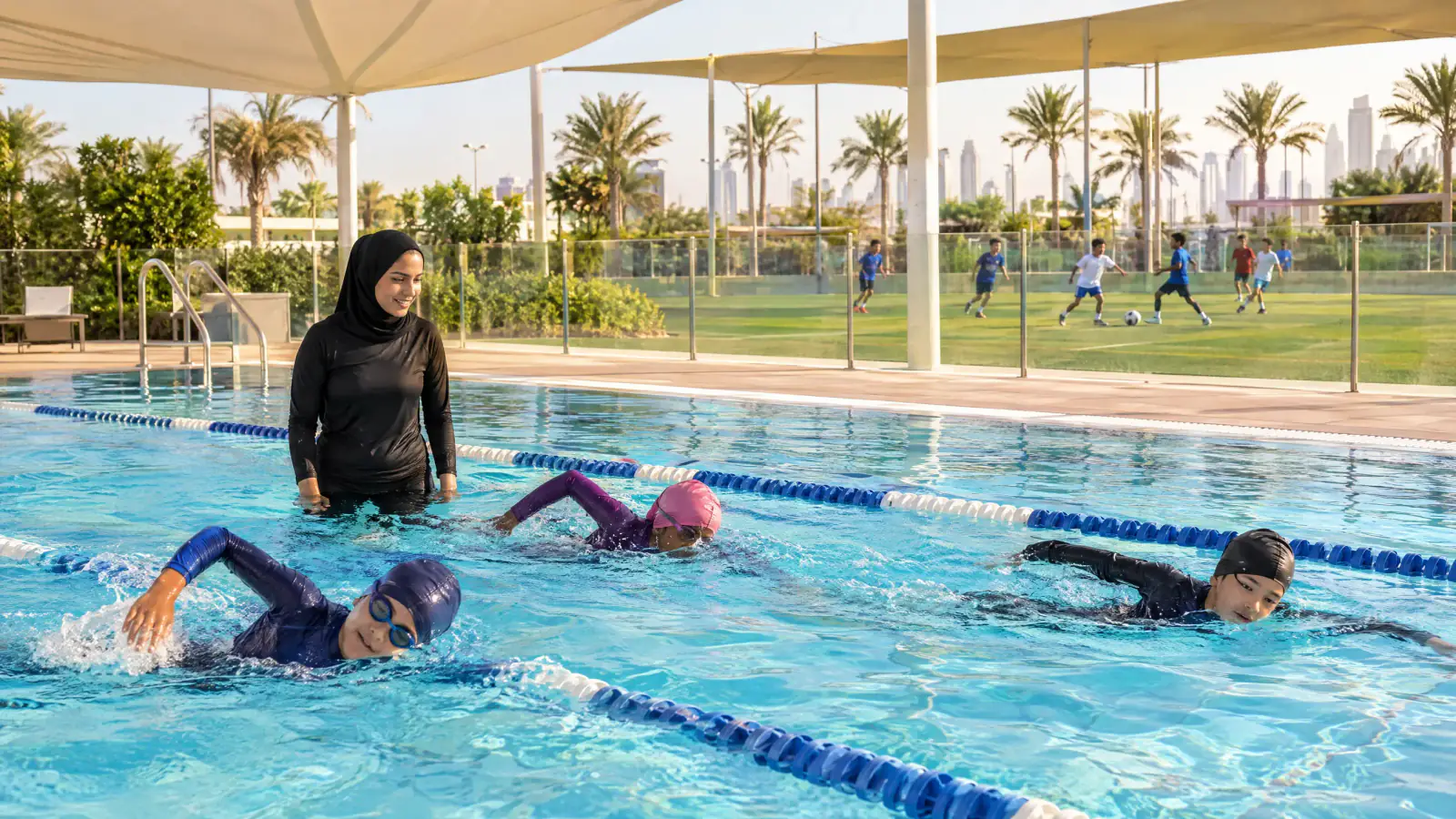
If your child plays football, someone has probably told you swimming would be good for them. Or the other way round. In Dubai, where so many families live near a pool and football academies are spread across the city, plenty of children end up doing both without anyone really deciding it.
It's a pairing the evidence supports, though not quite for the reasons people usually give. No study has tested "swimming plus football" as a package in children. But research on each sport, and on children who play more than one, points the same way. Here's what we found.
Swimming builds fitness and safety. It doesn't build bone.
Swimming is aerobic exercise, the kind the World Health Organization asks children aged 5 to 17 to do for "at least an average of 60 min/day" across the week (WHO 2020 guidelines, Bull et al.).
Where swimming falls short is bone. The water carries your weight, so there's very little impact, and bones get stronger in response to impact. A review of 64 studies found that swimmers had "lower bone mineral density than athletes who practise high impact sports and similar values when compared to sedentary controls" (Gómez-Bruton et al., 2013). A later meta-analysis of children and teenagers found the same, and the gap with high-impact athletes seemed to grow with age. Its authors concluded that swimmers "might be in need of additional osteogenic exercises", meaning bone-loading ones (Gómez-Bruton et al., 2016).
That isn't a reason to stop swimming. The 2013 review also found that swimming "does not seem to negatively affect bone mass". It's a gap, and something else can fill it.
Football fills the gap
Running, jumping, landing and changing direction are exactly the weight-bearing, impact-type movements bones respond to. A meta-analysis of 27 trials found that weight-bearing exercise programmes significantly increased bone mineral content and density in children and teenagers. The effects were small, and for bone mineral content they were largest in children before puberty who also got plenty of calcium (Behringer et al., 2014).

The WHO guidelines agree: on at least 3 days a week, children's activity should include "vigorous-intensity aerobic activities, as well as those that strengthen muscle and bone". A football session covers the vigorous, bone-loading part. A swim lesson adds aerobic fitness and a skill that helps keep them safe in water.
Swimming is a safety skill, not only a sport
This part is close to home. Dubai Municipality's pool safety guideline says its own accident investigations found that "the majority of drowning incidents involves children due to absence of adult supervision", and that "the best way to safeguard children is through teaching them to swim and providing them with the necessary adult supervision" (Dubai Municipality, 2020).
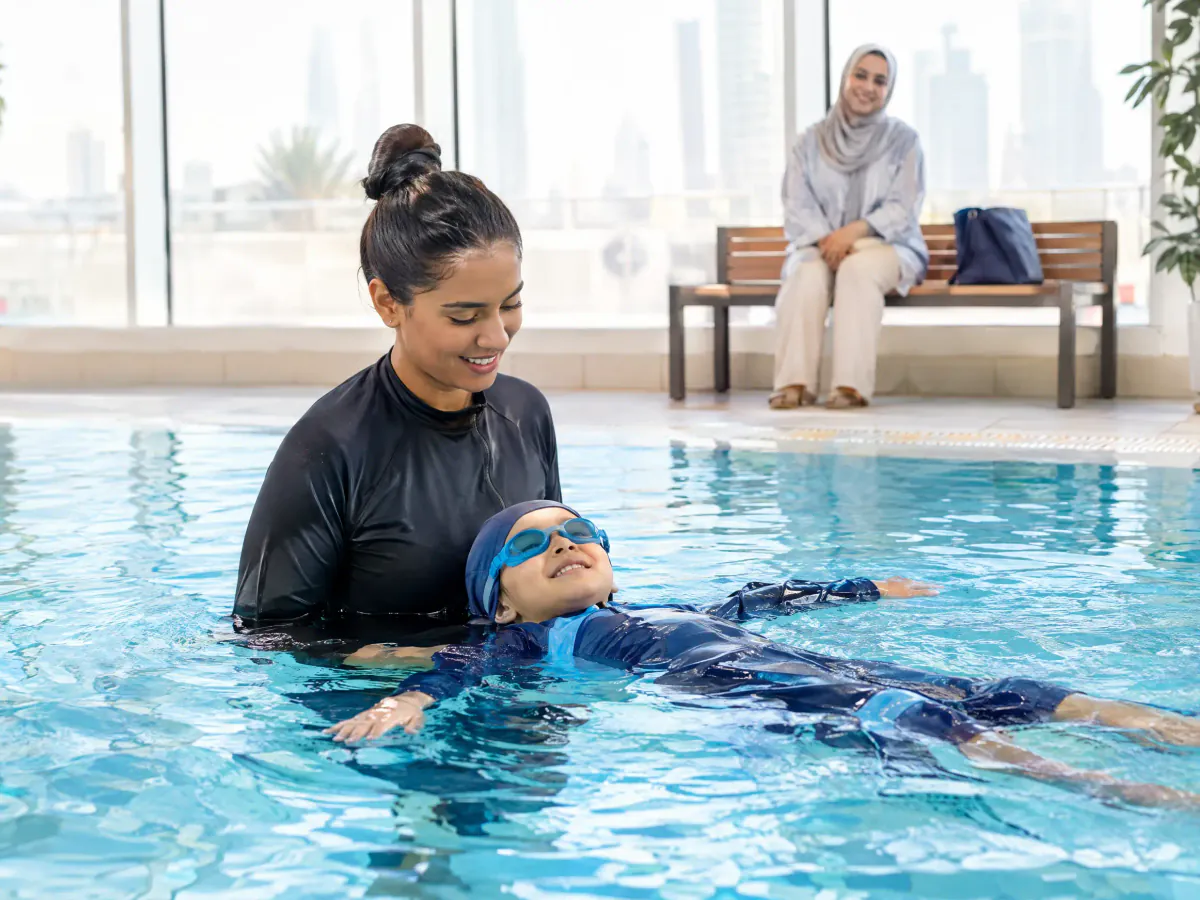
The American Academy of Pediatrics (AAP) updated its drowning advice in 2026. It says to "begin swimming classes in children after their first birthday", notes there is "no evidence that infant swim lessons reduce the incidence of drowning", and still asks for an adult who can swim to stay "within arm's length" of toddlers and weak swimmers (AAP, 2026). As the AAP's parent site puts it, lessons are "just one of several important layers of protection" (HealthyChildren.org).
Why two sports beat one at this age
The bigger reason to combine them is that playing more than one sport is what children's sports doctors advise. The AAP's report on specialisation says "participating in multiple sports, at least until puberty, decreases the chances of injuries, stress, and burnout in young athletes", and that for most sports, waiting until around 15 or 16 to specialise lowers the risks. It also advises at least 1 to 2 days a week off from a child's main sport, and at least 3 months a year off it in total, in blocks of a month, while staying active in other things (Brenner, AAP, 2016). Our guide to playing one sport or several looks at that evidence in more detail.
Swimming and football fit that advice because they ask such different things of the body: one is weight-supported and uses the whole body in the water, the other is on your feet, stop-start and heavy on the legs.
Does swimming prevent football injuries? No study has shown that. Coaches commonly use the pool for recovery, but the injury-prevention evidence is for something else: a structured warm-up. FIFA's 11+ Kids warm-up, built on balance, hopping, landing and falling drills, cut injuries by 48% in a trial of 3,895 young players (Rössler et al., 2018). Ask your academy whether they use it.
What it can look like by age
Around 5: swimming lessons make sense now, and football can stay as play. The AAP's report on organised sport says children under 6 "may not possess sufficient skills and attention span, even for simple organized sports", and that 6 "has been proposed as appropriate for most children to start organized sports" (Logan and Cuff, AAP, 2019). Plenty of Dubai academies start younger than that: of the 71 football academies on Waha that publish class ages, 54 take children aged 4 or under (checked October 2026). Filter by age on the football academies page to see which, and see which sports suit a 5-year-old for the wider picture.
Around 8: one or two football sessions and one swim a week covers both sides, leaves days without football, and keeps time for free play, which the same AAP report says children need every day.
Making it work in Dubai
The heat. From roughly June to September, afternoon football outdoors isn't sensible. Many academies run their weekly training in school terms, so the long summer break is camp season rather than league season, and during term sessions often run in the late afternoon or evening, frequently on floodlit pitches. A few list indoor options or adjusted times for the hotter months. Swimming is easier to keep going: several swim schools on Waha teach in indoor, shaded or temperature-controlled pools. So summer is a natural time to lean on swimming, which also fits the AAP's "month off" idea.
When your child does train outdoors in the heat, the AAP's heat statement advises building up over about 10 to 14 days and rescheduling to cooler times, "even if it means playing or practicing very early in the day or later in the evening" (Bergeron et al., AAP, 2011).
The school year. Most programmes follow school terms, so September and January are easy starting points. Half-term camps and holiday camps are a low-commitment way to try a football week or an intensive swim course first. The UAE school holidays guide has the dates of every 2026-27 break.
Choosing a swim school and a football academy
For swimming, the AAP's parent site suggests looking for instructors trained and certified through a nationally recognised learn-to-swim programme, a chance to watch a class first, lessons that teach safety and self-rescue skills, and a properly heated pool for children aged 3 and under. Browse swim schools in Dubai by area and age, ideally near school or your football academy, then message them on WhatsApp. Our guide to choosing a swim school has the questions to ask.
For football, look for an approach built on fun and development rather than winning, which the AAP links to children enjoying sport. Ask about group sizes and the warm-up, and see what age children can start football for what suits each age. Browse football academies in Dubai, and if your child is ready for league football, the Dubai youth football rankings show how clubs' teams are doing by age group. Prefer variety? Multi-sports classes mix several sports in one session.