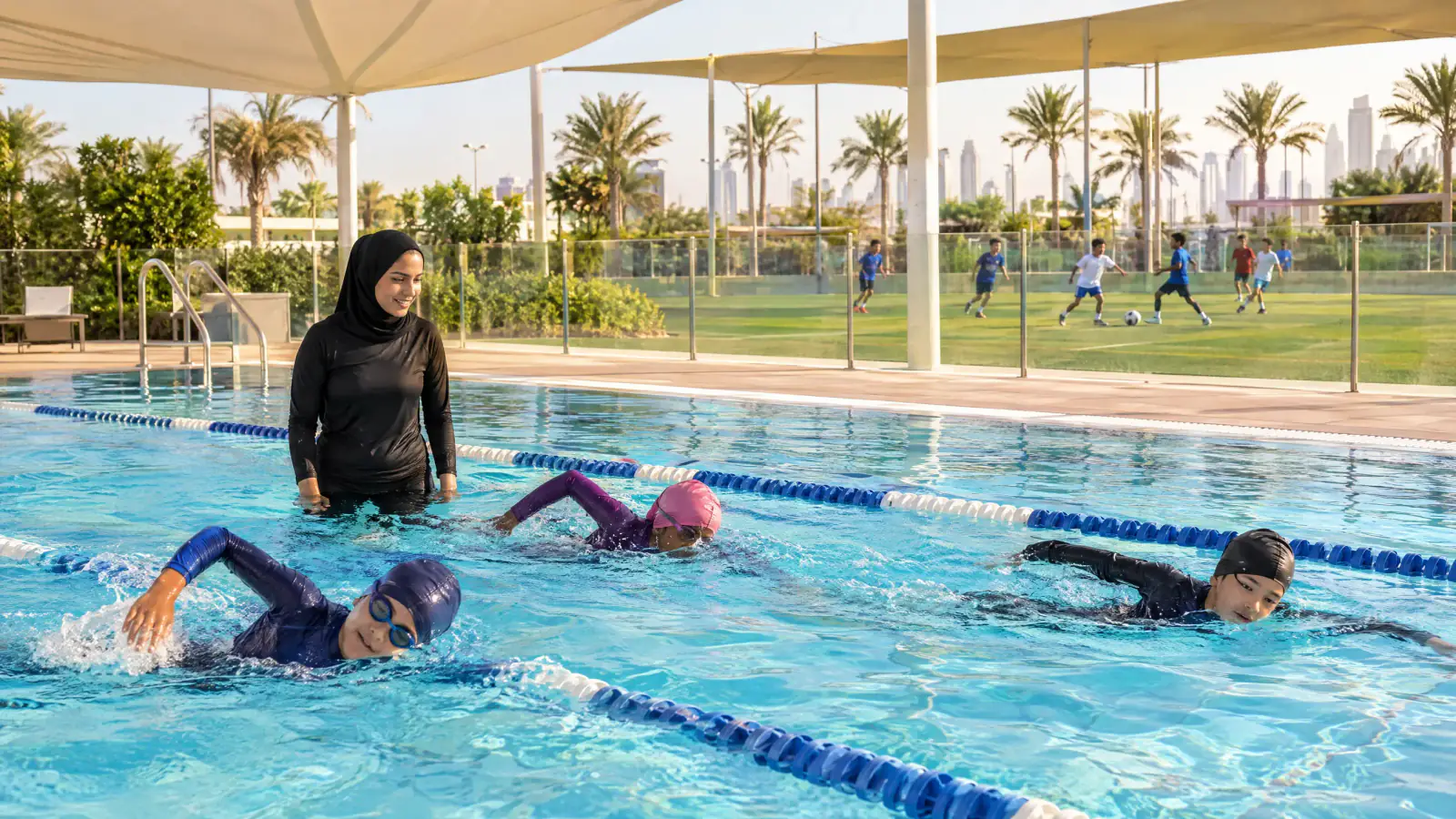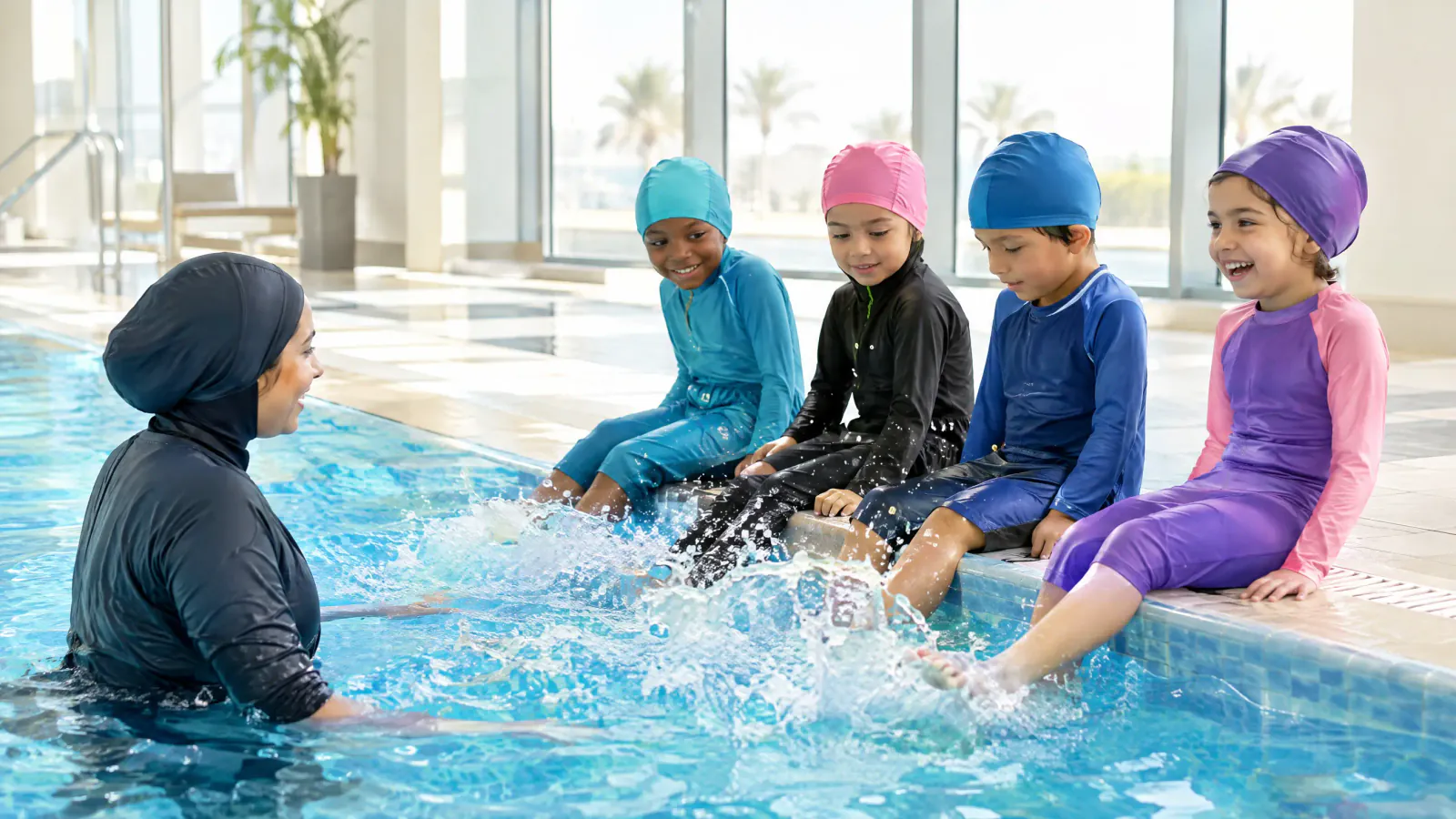
Pools are part of daily life in Dubai, in villa gardens and on apartment podiums. Dubai Municipality's pool safety guideline describes an "unprecedented increase of swimming pools" in homes and residential communities, and the drowning risk that comes with it (Dubai Municipality, 2020). With about 100 swim schools and coaches listed on Waha, the hard part is choosing.
Children's doctors have published a practical list of what a good swimming programme looks like, and most of it can be checked with a few questions before you book. Here's what it says, and how strong the evidence is.
Why lessons matter here
The World Health Organization (WHO) says children under 5 make up "nearly a quarter of all drowning deaths" worldwide (WHO, 2026). Closer to home, Dubai Municipality's own accident investigations found that "the majority of drowning incidents involves children due to absence of adult supervision", and its guideline says "the best way to safeguard children is through teaching them to swim and providing them with the necessary adult supervision".
How much do lessons help? The study most often cited compared 88 American families whose child had drowned with 213 matched families. Among children aged 1 to 4, formal swimming lessons were linked with an 88% lower risk of drowning, but the authors say their estimates "were imprecise": the true reduction could have been anywhere from 3% to 99%. For ages 5 to 19 the link was weaker and could have been chance (Brenner et al., 2009).
So the evidence is encouraging but not precise, and it comes from a study that looked back in time, not a trial. The American Academy of Pediatrics (AAP) counts "swimming competency" among proven ways to prevent drowning, alongside pool fencing, close supervision, life jackets on boats and early rescue, and says that "no single method is effective in preventing drowning" (Shenoi et al., AAP, 2026). Its parenting site puts it simply: lessons are "just one of several important layers of protection" (HealthyChildren.org).
When to start
The AAP's 2026 advice is plain: "Begin swimming classes in children after their first birthday" (AAP, 2026). Before that, its parenting site says there is "currently no evidence that infant swim programs for babies under 1 year old lower their drowning risk", though a parent-and-baby water play class is a fine way to get used to the pool.
For children aged 1 to 4, the same page says: "Studies suggest that water competency and survival skills training through swim lessons can help reduce drowning risk". By their fourth birthday most children are ready for lessons, and the AAP adds: "By age 5 or age 6, most children in swim lessons can master the front crawl."
Children are ready at different ages, so the AAP suggests weighing your child's maturity, physical abilities and comfort in the water; your GP or paediatrician can help if you're unsure. The babies and toddlers page and early years classes list parent-and-child options, and our guide to which sports suit a 5-year-old shows where swimming fits at that age.
Group lessons, one-to-one or a coach at your pool
Lessons usually come in one of three formats, and each can work.
Group lessons. What matters is how the group runs. The AAP's parenting site suggests watching whether children are "swimming most of the time" or spend "long periods" waiting for their turn. The WHO, writing about teaching school-age children to swim, asks for "student-instructor ratios established for safety", so ask the school what its ratio is.
One-to-one lessons give a child the instructor's full attention. For children under 4, the AAP notes that if you can't be in the water with your child or watch closely, "private classes that offer 1-on-1 instruction may be a better option."
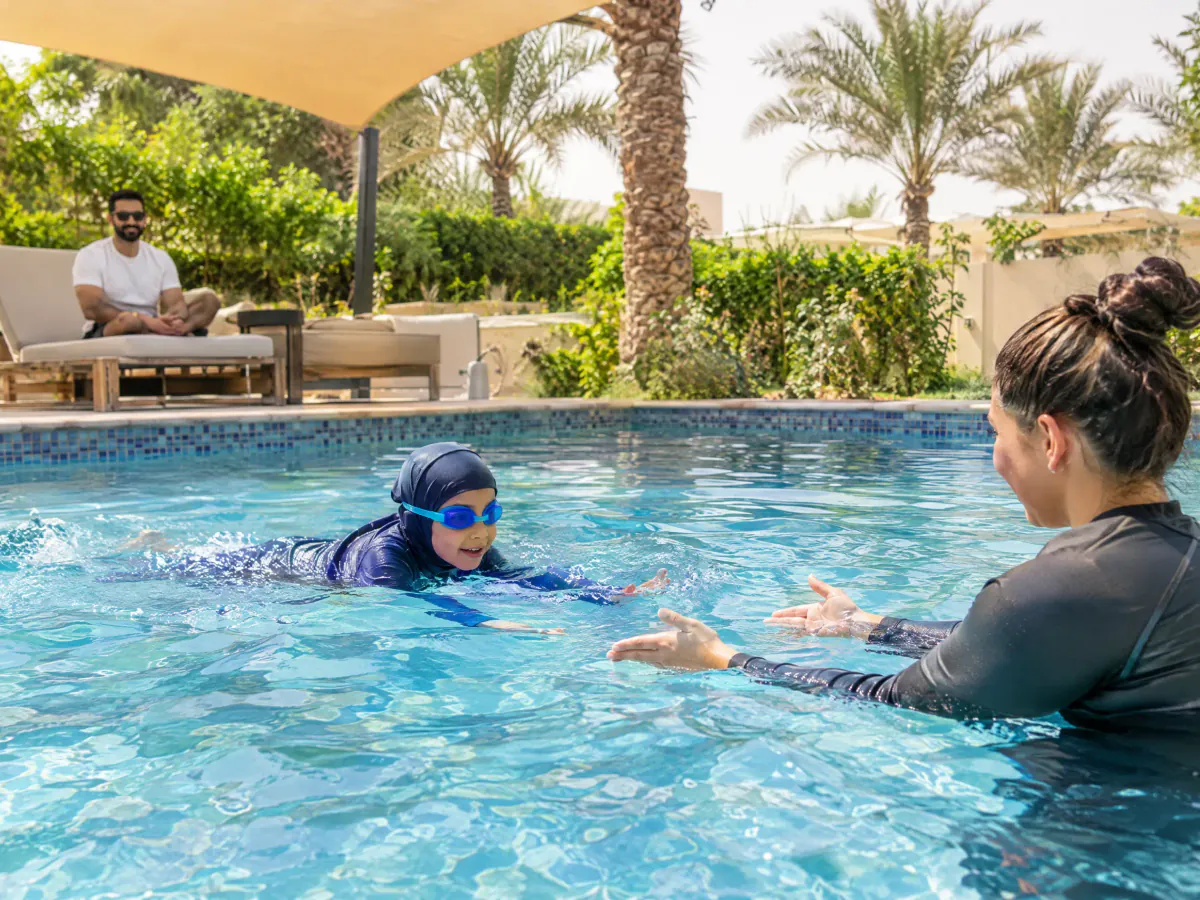
A coach at your pool. Several swim schools on Waha send a coach to your villa or community pool (checked October 2026), which saves a drive. Two things change at home. There's usually no lifeguard, so supervision is yours: Dubai Municipality's guideline asks for competent adult supervision whenever children use a private pool. And the pool your child learns in is also the one to secure between lessons. The AAP's parenting site says "the leading drowning risk for toddlers age 1-4 is unexpected, unsupervised access to water", and Dubai Municipality's guideline says a private pool's fence or wall should be at least 1.2 metres high.
What to look for in a swim school
The AAP's parenting site has a practical checklist (HealthyChildren.org). In short, look for:
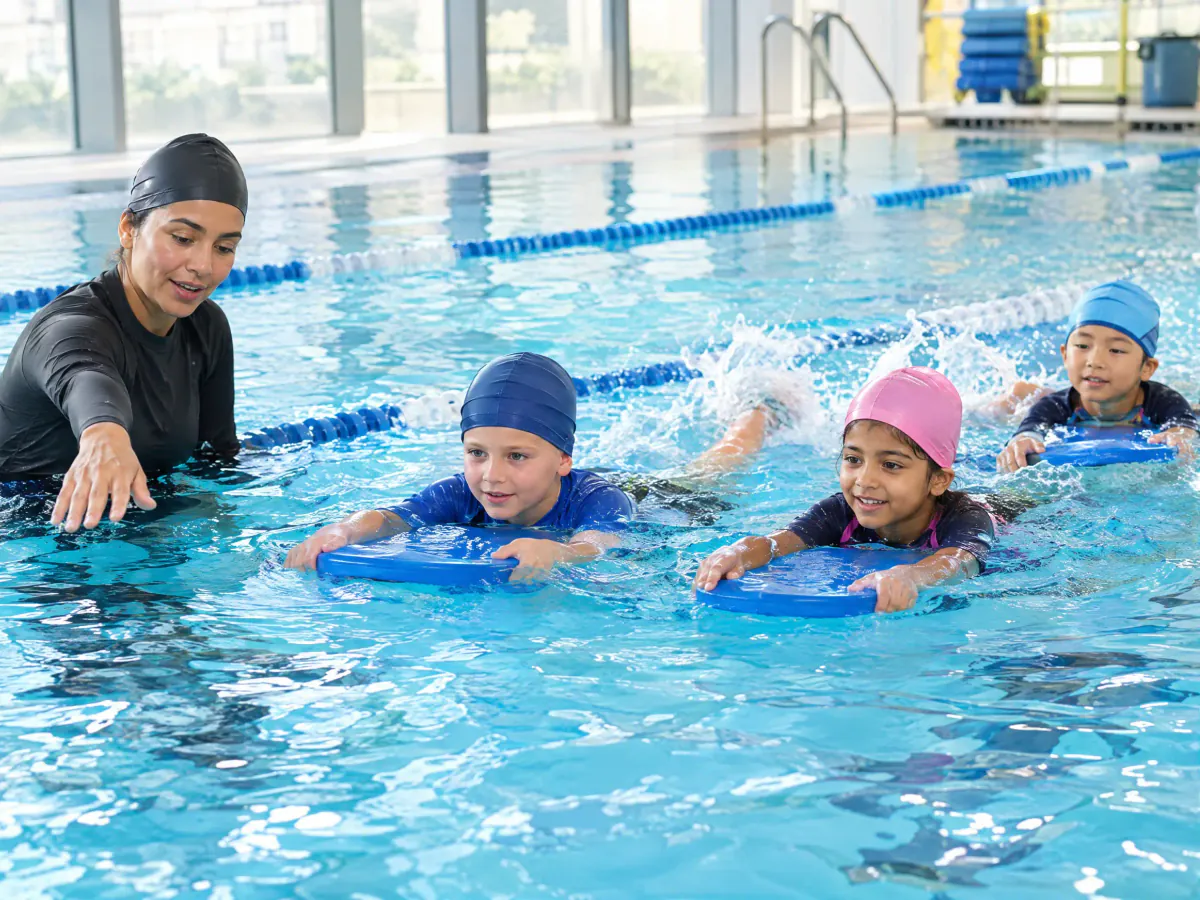
- Qualified instructors and a lifeguard. Instructors should be "trained and certified through a nationally recognized learn-to-swim curriculum", with lifeguards on duty who hold current CPR and first aid certificates.
- Water safety, not only strokes. Every child should learn to get back to the surface from underwater, swim at least 25 yards (about 23 metres) and get out of the water, and practise "falling in and swimming in clothes".
- A class you can watch first, to see whether it suits your child and whether children get some one-to-one attention.
- Steady progress over several sessions. You should see "gradual but consistent progress".
- For under-4s, a parent close by and warm water. An adult should be within arm's reach, which the AAP calls "touch supervision", parents should be encouraged to join in, and for children aged 3 and under the water should ideally be 87 to 94°F, about 31 to 34°C.
- Adapted lessons if your child needs them. The AAP notes that lessons can be adapted for children with special health needs, including autism.
Indoor, outdoor and the summer
The pool itself is worth asking about. Several swim schools on Waha teach in indoor, shaded or temperature-controlled pools, which keeps lessons going through the hottest months (checked October 2026). For an outdoor pool, ask whether it's shaded and what time lessons run between June and September. For babies and toddlers, ask about the water temperature in the cooler months too since, as the AAP puts it, "Hypothermia is a greater risk at this age."
Summer is a natural time to lean on swimming: outdoor sport is hard going in the heat, and a swim course or a holiday camp keeps a child active while their main sport pauses. Our guide to swimming and football shows how the two fit together.
For a confident swimmer, water sports and surfing are a next step. The sea is not a pool, so ask each provider what swimming level they expect.
What lessons cost
Prices depend on the format, the venue and whether a school sells lessons by the session, the term or in packs. Of the swim schools on Waha that publish a price, eight charge by the lesson (AED 65 to AED 350, median AED 105) and seven by the month (AED 345 to AED 1,200, median AED 450), checked October 2026. Our guide to what kids' activities cost in Dubai has the rest. When you compare quotes, check what each one covers: lesson length, group size, and whether there's a registration or kit fee as well.
Questions to ask before you book
A short message to the school covers most of the checklist:
- Which learn-to-swim programme are your instructors certified through, and is there a lifeguard on duty?
- How many children are in each group, and how many instructors are in the water?
- Can I watch a class or book a trial, and how will I hear about progress?
- Do lessons teach water safety, such as getting out of the pool after falling in?
- For under-4s: does a parent join in the water, and how warm is the pool?
- Is the pool indoor, shaded or outdoor, and what happens in summer and over the school holidays?
- Is the price per lesson, per term or for a pack, and what does it include?
Then browse swim schools in Dubai by area and age, and shortlist a few near home or school. Whichever you choose, lessons are one layer of protection, not a replacement for an adult close by. If swimming is one of several activities, our guide to playing one sport or several covers how to balance the week.