If your child plays football or rugby, a dance class might not be the first thing you think of. Yet some well-known athletes grew up doing both. Rio Ferdinand, who won six league titles with Manchester United, spent four years in ballet classes in London as a boy, and he has said ballet and gymnastics helped his football.
So should a sporty child try ballet or hip hop? The research says dance builds balance and movement skills in children. Whether it makes them better at their sport hasn't really been tested. Here's what the athletes say, what the studies found, and how dance can fit around sport in Dubai.
Rio Ferdinand's four years of ballet
Ferdinand grew up on an estate in Peckham, in south London. Interviewed by The Observer in 2007, he said: "Then I won a scholarship when I was 11 to go to the Central School of Ballet. I did ballet at first because it allowed me off my estate." He took the bus to classes in Farringdon and kept it quiet from the older boys he played football with: "I wouldn't have told them about ballet or I would've got ripped. But by the time I was 13 some people knew and I didn't care." (Jackson, The Observer, 2007)
A second Observer interview, a year later, says he went "four times a week for four years", while also training with several football clubs (Llewellyn Smith, The Observer, 2008).
Looking back in 2023, when he joined the league's Hall of Fame, he said of his parents: "They encouraged me to try anything and everything, like ballet and gymnastics. There's no doubt these things contributed to my football-playing ability in terms of balance, poise, and agility." (Hall of Fame interview, 2023)
That's his own view, looking back. But it wasn't a few taster sessions: it was years of regular classes alongside football.
Other athletes who started in a dance studio
Four more athletes whose dance training is well documented:
- Georgi Kinkladze, the Georgian midfielder who starred for Manchester City in the 1990s, took traditional Georgian dance lessons as a child. He told FourFourTwo: "Taking dance lessons gave me the core strength to change direction instantly while keeping my upper body still. People said I looked like I was gliding when I played; that was thanks to the dance training" (Chicken, FourFourTwo, 2026).
- Zoe Aldcroft, the England rugby forward named World Rugby's player of the year for 2021, took ballet, tap and disco lessons and balanced dance with rugby and netball until she was 15. She compares remembering a dance routine with remembering line-out moves: "To me they are actually very similar things" (Rowan, The Telegraph, 2020). Dance didn't prepare her for everything, though. In her first rugby sessions she was "nervous about the contact element because I used to do ballet and dancing, where there wasn't any contact" (England Rugby, 2022).
- Vasiliy Lomachenko, the Ukrainian boxer who won Olympic gold in 2008 and 2012, was sent by his father to traditional Ukrainian hopak classes at the age of 9, "every day after school for the next four years", to work on his footwork. He told Sports Illustrated that "everything comes out of my footwork" (Bishop, Sports Illustrated, 2018).
- Lynn Swann, the Pittsburgh Steelers receiver now in American football's Hall of Fame, studied ballet, modern dance and tap "from the age of four until his senior year in high school", after his mother enrolled him to use up some of his energy. Of his primary school years, he recalled: "I felt more comfortable on the dance floor than the football field" (Pro Football Hall of Fame).
These are stories, not evidence. Athletes who made it can't know how they would have played without dance, and nobody hears from the children who danced and didn't. What the stories do show is that dance and sport can sit side by side in a childhood, often for years.
What dance trains
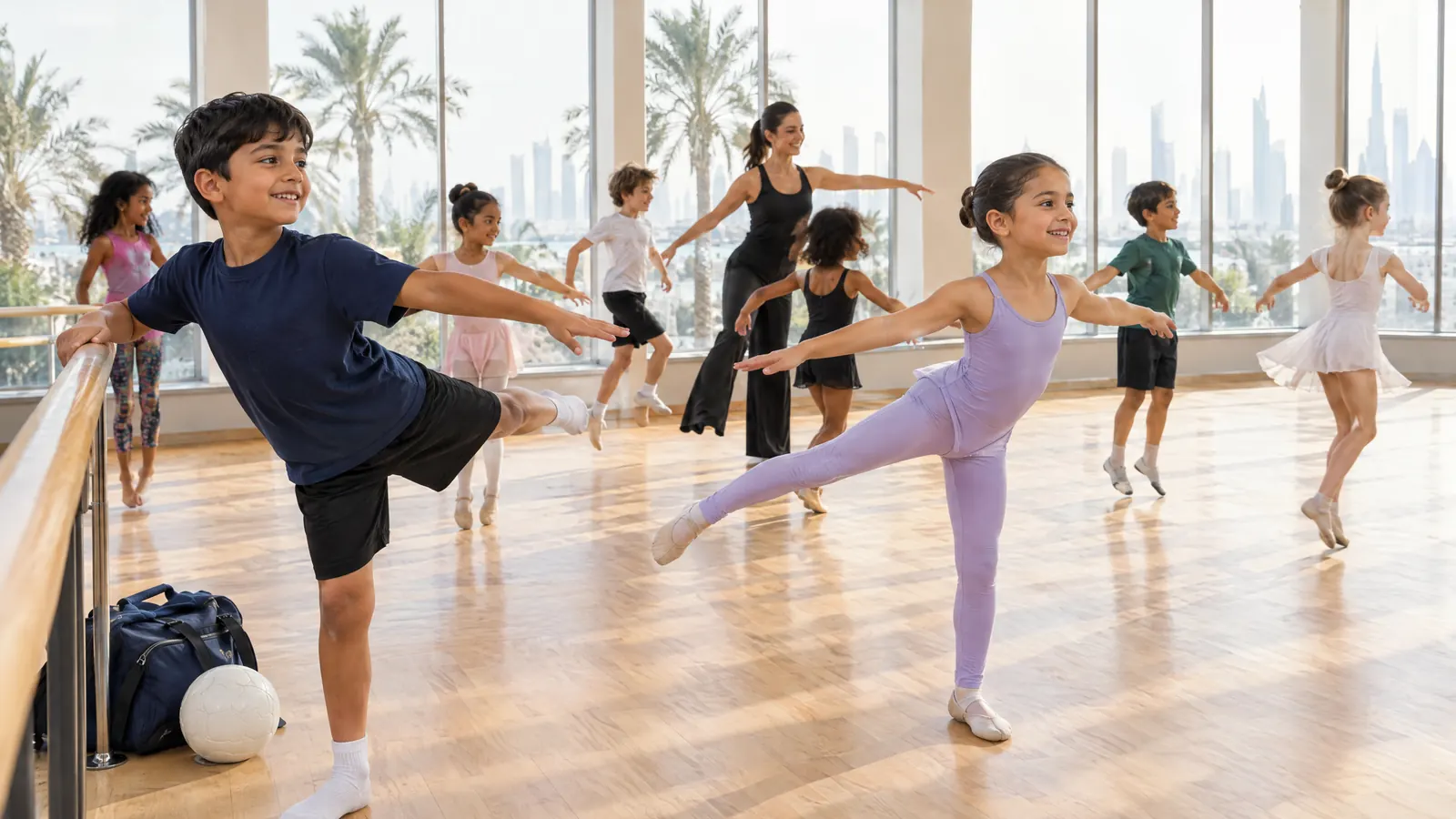
Whatever the style, a dance class asks children to balance, turn, jump and land, to change direction in time with music, and to remember a sequence of steps. Ballet puts the weight on balance, posture and control; hip hop and street dance on rhythm, quick footwork and moving freely.
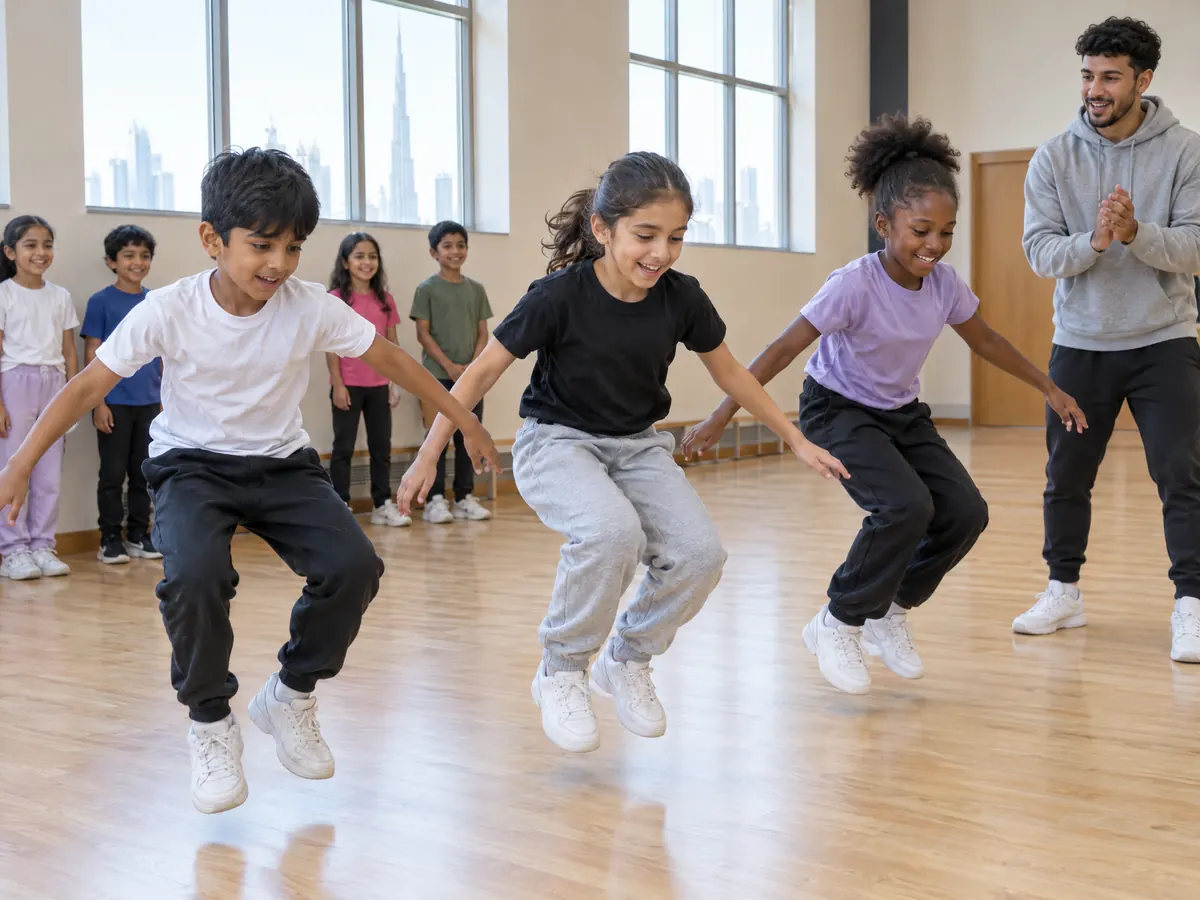
The research in children backs up the movement side. A 2026 review pooled 21 trials with 2,496 children and found that dance and rhythm-based programmes improved motor competence, meaning general movement skills, on average. Its authors rated the certainty of that evidence as low, and the effects varied a lot from one programme to another (Luo et al., 2026).
Single trials point the same way. In one primary school, 41 children aged 9 to 11 were randomly assigned either to two 45-minute aerobic dance sessions a week for 8 weeks or to carry on as usual. The dance group improved on several balance tests, though not on all of them (Jouira et al., 2024). In a 12-week trial with 80 preschool children, both dance groups improved their movement skills, including balance, more than children doing standard PE (Đošić et al., 2025).
These are small, short studies: they show dance can build these skills, not that it builds more of them than another sport would.
Does dance make children better at their sport?
This is where the evidence runs thin. No trial has tested whether dance classes improve children's performance in football, rugby or any other sport.
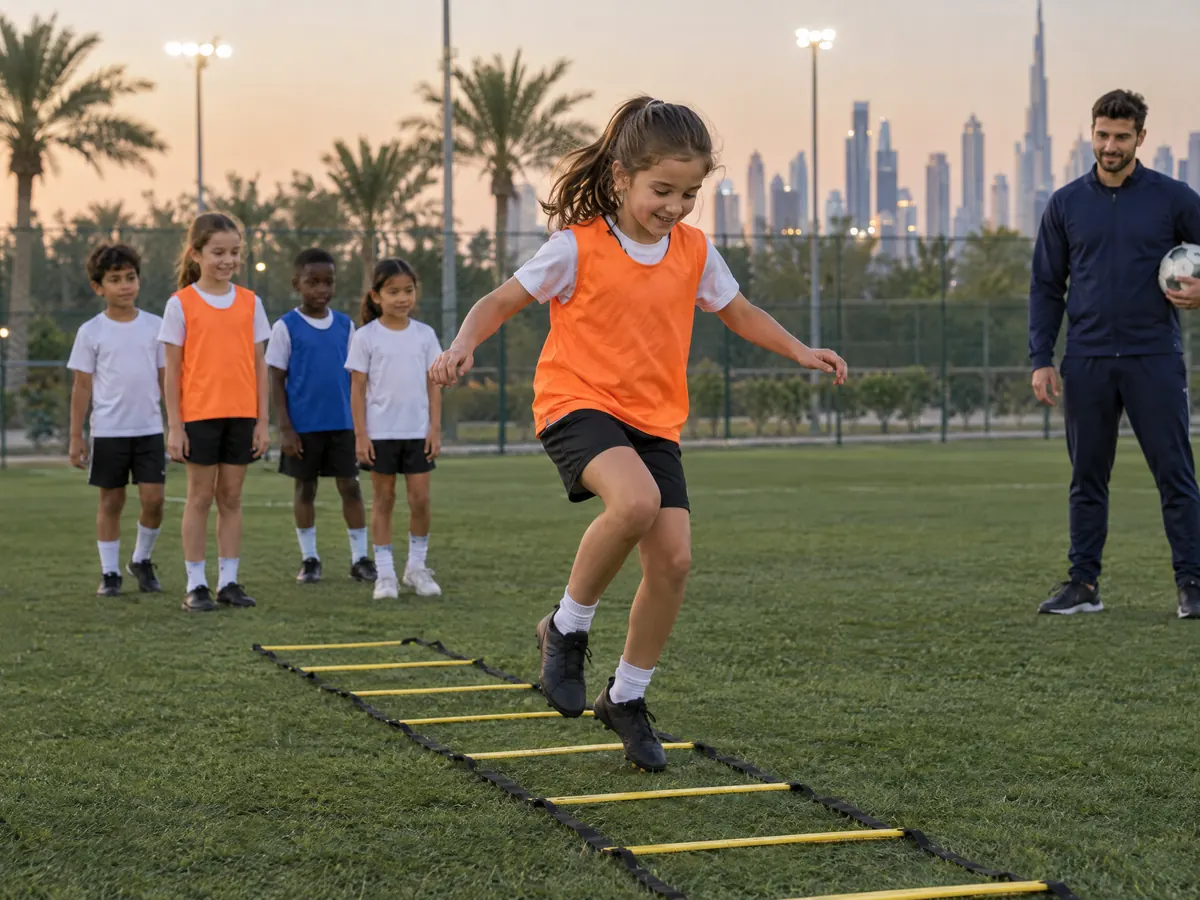
What exists are comparisons of adults. In one, 32 college dancers and 32 college footballers, all women, stood on a pressure mat: the dancers scored better on 5 of 20 balance measures and the same on the other 15 (Gerbino et al., 2007). In another, 40 elite ballet and modern dancers and 40 team-sport athletes landed on one leg from a 30 cm step. The dancers kept their upper bodies steadier, and the female athletes' knees moved inwards more, a pattern linked with anterior cruciate ligament (ACL) injuries. The authors note that "the incidence of ACL injuries among dancers is much lower than among team sport athletes" (Orishimo et al., 2014).
But these studies compare people who chose dance with people who chose sport. They can't show that dance caused the difference: people with good balance may simply be drawn to dance.
The one study we found that put athletes into ballet classes was a small pilot: 10 American college football players, some of them doing three 30-minute ballet classes a week for two weeks. Their balance didn't improve compared with the others. Their agility test times got faster, but the short report doesn't say whether the comparison group's did too (Maleki et al., 2019). Ten players over two weeks can't tell us much.
So: dance builds balance and body control, and dancers land differently from many athletes. It's reasonable to think some of that helps on the pitch, as Ferdinand and Kinkladze believe, but it hasn't been shown.
What does cut sports injuries
If you're hoping dance will protect your child from injury, there's better evidence for something else. FIFA's 11+ Kids warm-up, built on balance, hopping, landing and falling drills, cut injuries by 48% in a trial of 3,895 young footballers (Rössler et al., 2018). Dance practises some of the same skills, but it hasn't been tested this way. Ask your child's academy whether it uses a warm-up like this.
Dance as a second activity
The clearest case for dance is the case for any second activity. The International Olympic Committee says that "diverse athletic exposure and sport sampling enhance motor development and athletic capacity" in children (Bergeron et al., IOC, 2015). Our guide to playing one sport or several covers that evidence.
Dance also sits well beside a ball sport. Football, rugby and cricket train kicking, catching and reading a game; dance trains balance, rhythm and moving the whole body, without the contact. That's our reasoning from the evidence above, not a tested combination. Our guide to gymnastics and martial arts compares two more indoor options.
In Dubai, dance has one more thing going for it: it's taught indoors, so it carries on through the summer, when outdoor football often pauses or turns into holiday camps. It can be the main activity in July and August and the second one in term time.
Which style? No study compares dance styles for young athletes, so let your child choose. Ballet may suit a child who likes precision and routine; hip hop or street dance one who would rather move to music they know. If your son thinks ballet is only for girls, Ferdinand, Swann and Lomachenko are good names to mention.
Browse dance classes and ballet schools by area and age, ask for a trial class, and see whether your child comes out smiling. Football academies and gymnastics clubs are listed the same way. For younger children, see which sports suit a 5-year-old, and if the week is filling up, how many activities is too many.